
The Path of Satisfaction
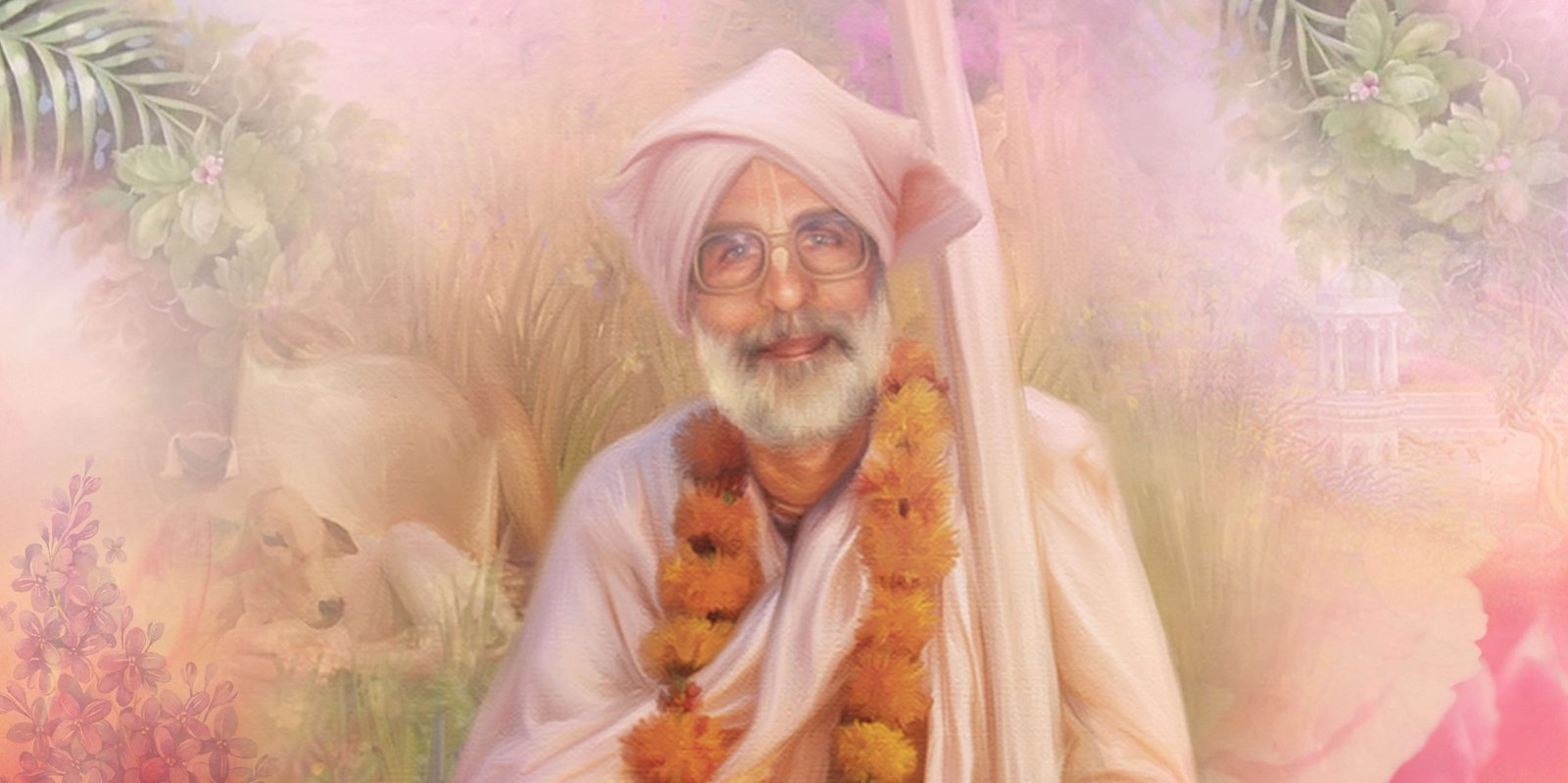
Hari-katha by Sripad Vasanta Prabhu
2025 November
Vaiṣṇavas are very merciful. They come, they serve, they give example to everyone, inspiring others through constant selfless service. The high-class Vaiṣṇavas give their lives in this way. Their eternal life is to glorify Śrī Kṛṣṇa, Rādhārāṇī, Mahāprabhu, Śrī Guru, and the Vaiṣṇavas. Thus, Śrīla Śrīdhar Mahārāja speaks beautiful hari-kathā, carrying forward this living current.
It is essential to continue this tradition of hari-kathā every day—to cultivate desire in the heart for sādhu-saṅga, for spiritual advancement, for sevā, for association with the Vaiṣṇavas, and for listening to their hari-kathā. Even when a high-class Vaiṣṇava is not physically present, the Vaiṣṇava remains present through legacy, through bhajana. The bhajana of the Vaiṣṇavas never disappears, because bhajana is of spiritual substance.
If we are sincere—if our prayer is constant and genuine—then Rādhārāṇī will surely be present, the Vaiṣṇavas will be present, and their holy presence will manifest. Therefore, the prayer is one alone: may desire and taste awaken in my heart—for association, for hari-kathā, for sevā. Gradually, the heart transforms, taste arises, and one advances on the path of self-realization.
Without constant sādhu-saṅga, advancement in spiritual life is impossible. For this reason, prayer centers on sādhu-saṅga. Some think that by chanting a fixed number of rounds—sixty-four, or any number—desire for association and hari-kathā will automatically appear. But without association, no amount of chanting bears fruit. Kṛṣṇa is present only when the holy name is chanted as śuddha-nāma. Without love, it is not truly Kṛṣṇa’s name that is being chanted.
It is like dialing a phone number without a SIM card. One may dial ten thousand times, yet the call will never connect. Fanatic repetition—Hare Kṛṣṇa, Hare Kṛṣṇa—cannot substitute for connection. The SIM card is Sri Guru. When Gurudeva is present, a single call goes through. Therefore, guru-bandhana is indispensable.
Before chanting Kṛṣṇa’s name, one must take shelter of Gurudeva. Otherwise, chanting follows the mind’s projections, while the heart remains clouded by material desire. Association brings humility; prayer naturally arises. Thinking subsides. Often, in moments of suffering, one turns toward the Vaiṣṇavas, and through their mercy, life regains balance. Yet once relief comes, association is abandoned, and the cycle repeats—because the conditioned mind moves in circles.
For this reason, the association must be relentless. When one cannot physically come, one should still remain connected—present where service and remembrance continue. But abandoning association altogether for the pursuit of material occupation and distraction leads only to restlessness and confusion. From the highest perspective, it is always the same refrain: need money, need this, need that. This vision is incomplete.
Kṛṣṇa provides everything. When the association is genuine and the chanting sincere, nothing is lacking. Kṛṣṇa is never without resources.
Everything will be given. Kṛṣṇa is never without resources. The sun and the moon, the planets and the entire solar system, the asteroids, the very air we breathe—everything comes from Kṛṣṇa. He has given everything; therefore, He is the possessor of everything. Remember Annakūṭa—it is very important. At Annakūṭa, we realize how wealthy Kṛṣṇa truly is. Why? Because He is holding Govardhana, which represents devotion. This is the power of devotion—the shelter of sādhu-saṅga. Govardhana itself is āśrama.
Kṛṣṇa is protecting all devotees. He holds the āśrama for them, and therefore nothing can harm those who take shelter. He shelters everyone beneath Govardhana. Govardhana means abundance—but abundance of what? Devotion. When devotion is present, there is no need to worry about anything at all. Material desires may arise, but they do not touch the heart.
Without association—how can devotion ever appear? Therefore, one must always take shelter of the Vaiṣṇavas and remain in association. Many people think, “For some time, I will continue like this. Then I will get married, have children, do this and that.” Never go away. Whatever one does in life—whatever one feels compelled to do—let it be done, but association must never be abandoned. Better not to pursue distraction at all, because it brings suffering; but even if one does, as long as association is maintained, some advancement remains possible. Without association, there is no advancement.
What, then, is advancement? Advancement means that when one calls Kṛṣṇa, one calls with love—not to ask for something, but to say, “How are You? What can I do for You? Are You happy?” It is the call of offering, not demand: “I am not asking for anything. I have already prepared something—please come.” Without this mood, chanting becomes mechanical—repetition without relationship, fanatic insistence without heart.
Sometimes this fanaticism expresses itself in austerity. When Janmāṣṭamī comes, some fast without water, without grains, without food, even holding the breath—turning the body purple in the name of devotion. Then they become black like Kṛṣṇa—not for Kṛṣṇa, but for themselves. This is not bhakti. Whatever is offered should be offered to Kṛṣṇa—then it has meaning.
Austerities are meant only to restrain the impulses of the body, the many tendencies of the senses that seek enjoyment. But harming the body, forcing the breath, or cultivating extremity is not devotion. This kind of fanaticism misses the point entirely.
If Guru says, “Chant sixteen rounds,” then chant sixteen. If Guru says two, chant two. If Guru says thirty-two, chant thirty-two. But if Guru has not instructed it, then what is being done? It is like a kindergarten child being handed advanced algebra. The formulas may be correct, but the capacity is not there. Without guidance, excess does not lead to growth.
In the same way, chanting without relationship and direction has a limited effect. Guru will indicate when and how practice should deepen. Without a relationship with Kṛṣṇa—without knowing who Kṛṣṇa is—how can excessive chanting bear fruit? Some benefit may arise: the mind may turn more often toward Kṛṣṇa, and interest in hari-kathā may awaken. But what often happens instead is that the heart remains fixed in demand: “Give me more. Give me more. Give me more.”
This is not bhakti. Bhakti awakens through association with Guru. Through that association, bhakti is learned not as a theory, but by living example.
What is Guru doing? Always serving. The essential quality of a Guru is ruci—a deep taste for his own Gurudeva. From that taste naturally arises sevā-vṛtti, the inclination to serve. There is an innate tendency to serve the Vaiṣṇavas, and whenever an opportunity for service appears, joy immediately follows.
“Today Kṛṣṇa has blessed me—I have the opportunity to serve the Vaiṣṇavas.”
“Today I can do kīrtana in sādhu-saṅga.”
“Today I can take darśana of Ṭhākurajī.”
Joy arises again and again.
This is not something to be endured or forced. Bhakti is not an achievement wrestled from resistance, like pushing a heavy stone up a hill. Kṛṣṇa never said, “Push a big stone up Govardhana.” Yet many imagine this to be devotion and become proud of their struggle: “Look how much I have carried.” But Govardhana is already full of stones.
Rather, one is meant to take shelter of Govardhana. By taking shelter, a relationship with the Vaiṣṇavas comes naturally and sweetly. And from that, a relationship with Kṛṣṇa also arises—without strain.
Otherwise, one merely associates with the mind. And what comes from that? Pain and suffering—because the mind is limited. We think we know sweetness, yet we do not. We think we know stability, yet we do not. We believe we know how to live without asking or taking, but we do not. These qualities belong to love, and love is learned only through association.
Gradually, the heart begins to change. When the heart opens to Vaiṣṇava-saṅga, true transformation begins.
As for desire: the impulse to marry, to have children, is strong in almost everyone. Especially in youth, this is natural and need not be condemned. Hair grows. Nails grow. One cannot negotiate with them. One may tell them to stop, but they do not listen. Monks shave—by a blade, they stop the growth. But if one is not a monk, the impulse remains.
With time, maturity brings understanding. One begins to see why restraint is praised—because attention shifts. Instead of Kṛṣṇa, focus moves toward family life. Then bhakti requires greater effort. Time becomes scarce, and when time appears, fatigue follows.
Children require immense energy. As they grow, activity increases—movement, sound, restlessness. The mind rarely settles. One sits to hear hari-kathā, yet exhaustion prevails. This is why parents are perpetually tired.
And yet, even here, association remains the key.
Whatever little time we have, it is better not to spend it alone. One should come and associate. Even once a week is good—come for a day, associate with the Vaiṣṇavas, cook together, do some sevā. Let that association nourish the heart. Building something, cooking something, engaging in simple activities, decorating the āśrama—filling the āśrama with sevā. Through such engagement, sambandha with Kṛṣṇa gradually awakens. Otherwise, what real advancement will there be by the end of life?
So many people speak endlessly about this and that—opinions without end. Yet when there is no sambandha with Kṛṣṇa, all of it remains material noise. What we truly seek is association with one who lives in a full, loving relationship with Kṛṣṇa. When such an association is present, the impulse to identify with the material body begins to weaken. The body loosens its hold; it no longer feels essential.
It is like giving a PlayStation game to someone who does not own a PlayStation. “Why are you giving me this? I have no console—how can I play?” In the same way, when identification with material life fades, material programs lose their attraction. They may be offered, but the heart responds, “I have no use for this.” Renunciation then occurs naturally, without struggle.
When the console is present, the games naturally appear—the game of marriage, the game of children, the game of worldly engagement. “Try this one. Put this on.” As long as the material body is taken as the self, material life can be run. But as identification is purified, spirituality becomes simple: this material possibility no longer defines me.
Still, as long as the body remains, dharma remains. There is varṇāśrama-dharma. If one is married, children should be raised responsibly. If one is a brahmacārī, one should dedicate one’s life to study and service. Each position has its appropriate engagement.
Yet honesty is required. One can observe that many young people, even when opportunities are present, lack interest. There is no chanting, no focus, no discipline. Everything is available, yet there is no remembrance, no effort. When they travel to holy places, the same pattern continues—restlessness, distraction, superficial engagement. The Vaiṣṇavas are infinitely kind and tolerant, yet the truth must be acknowledged: there is often no qualification, no adhikāra, because there is no genuine desire.
Instead, the mind is absorbed in personal fulfillment—how to enjoy, how to negotiate advantage, how to secure comfort. But the desire to serve—this is rare. Such desire does not arise in one lifetime. It comes from many lives of cultivation. This can be seen clearly. A sincere Vaiṣṇava naturally desires to serve the Vaiṣṇavas, to associate, to hear Bhāgavatam, to remain in devotional company. This sincerity is not accidental.
Some children are drawn to Bhāgavatam from a very young age—reading it, speaking about it, absorbing its meaning effortlessly. This does not appear suddenly. It is the fruit of many lifetimes of practice. That is one stage.
Then comes the next stage: the realization, “I do not know anything. I must listen to high-class devotees.” At this point, the desire to hear from senior Vaiṣṇavas awakens. This is why guru-bandhana is essential. One may read Bhāgavatam extensively, but without Gurudeva, true understanding does not arise—even if the entire scripture is read.
Therefore, the primary desire that must awaken in the heart is the desire for association—the desire for sādhu-saṅga. While this desire is being cultivated, we must look honestly into our own hearts. With whom do we truly wish to associate? Whom are we seeking? Often, it is someone who can offer psychological comfort, emotional reassurance, or relief for the senses. This is usually the kind of association we pursue.
But true association is association with the Vaiṣṇavas. We may say, “I have a strong desire to associate with the Vaiṣṇavas,” yet in truth this desire is often still weak. When the desire for Vaiṣṇava-saṅga becomes stronger than all other desires—when it rises above everything else—then the spiritual path truly begins. This is called the awakening of faith.
We often say, “I have faith,” but what do we really mean by faith? Frequently, it means, “Give me, give me, give me more.” Or we cry, “O Kṛṣṇa, I am suffering so much—please take me out of my pain.” Everyone remembers God in the hospital. When crisis comes, when sickness appears, remembrance awakens: “Please save me from this suffering.” It is like saying, “I broke my PlayStation—please fix it.” But this is not faith.
We pray, and Kṛṣṇa responds—He is infinitely kind. The PlayStation is fixed. And then what do we do? Do we begin running higher programs? No. Immediately, we return to the same material patterns. As soon as life functions again, association disappears, and we resume the search for bodily comfort, psychological reassurance, and emotional gratification. This is not spiritual advancement.
Spiritual advancement begins only when the desire to associate with pure devotees becomes the primordial desire of the heart. The foremost longing must be this: I must listen to hari-kathā. No matter what happens—do or die—I must listen to hari-kathā and remain in association. When this desire is present, one can know that genuine advancement has begun.
For this reason, mere solitary reading—purely intellectual engagement—is of little value. What can truly be understood alone? When one listens from the lips of a pure devotee, what is received is not information but transmission—what the devotee himself is carrying in the heart while reading. That is association: sitting in hari-kathā and listening from the lotus lips of the Vaiṣṇavas, hearing how they speak the Bhāgavatam.
Without entering into modern language, it can still be said clearly: when Gurudeva reads the Bhāgavatam, love for the Bhāgavatam is vibrating. It is a transcendental vibration. His presence is transcendental. What emanates from his consciousness—what moves in his words—is entirely different from what arises from one’s own conditioned heart.
One truth must be understood deeply and without compromise: I am a baddha-jīva. I am a conditioned soul. Without association, there is no hope. If this is not understood—if one continues to follow one’s own mind, or those who have not realized their conditioned state—how can advancement occur? This is why the scriptures and the saints place such overwhelming emphasis on sādhu-saṅga.
Whenever the Vaiṣṇavas come, some effort is naturally made. Yet sometimes this effort resembles a yearly celebration—something awaited occasionally, received briefly, and then allowed to pass. But the Vaiṣṇavas are not measuring frequency; they are looking for sincerity in the heart. And sincerity alone is not enough—responsibility must also be present. One must take responsibility for one’s own opportunity. The Vaiṣṇavas are always offering opportunities, but if they are not accepted, how can advancement take place? It is like a water fountain filled with fresh water: the water is there, but unless one approaches, takes a vessel, and drinks, thirst will remain. The fountain cannot drink on one’s behalf.
There is a clear sign of progress in spiritual life: the awakening of desire for hari-kathā and for association. As long as the desire to surrender has not arisen—so long as the wish to speak, instruct, or assert remains stronger than the wish to surrender to a genuine teacher—there is a serious imbalance. Observing truly advanced devotees, one sees that surrender is central to their lives. Their longing becomes very simple: to meet saints of the highest order, to remain connected with the line of pure devotion, and to allow no day to pass without some form of association with elevated Vaiṣṇavas.
Often, however, one becomes absorbed in activity and distraction, neglecting the words of the ācāryas altogether. Such a day, though lived outwardly, is inwardly lost—a material day, yielding no lasting substance. But when even a small amount of association is preserved each day, the inner condition changes. In the present age, this is not difficult. Hari-kathā is readily available, carried through the words, recordings, and writings of realized souls. Association is accessible for those who seek it. The obstacle is not availability, but intention.
When there is genuine desire, the bhakti-latā begins to grow. One can see this clearly: wherever there is a taste for hearing, the creeper of devotion begins to blossom. Among younger practitioners this taste may not yet be fully developed, and this is natural. Still, even then, one can cultivate the desire to support continuity—to remain connected to remembrance, to sustain the current of hearing and reflection.
Often there is reliance upon elders to carry the weight of spiritual momentum. Yet responsibility must gradually be assumed. If senior devotees are not physically present, their words must still be remembered. This remembrance must not be occasional; it must be continuous. There should be no uncertainty—no question of whether remembrance will happen or not. It must happen daily. Continuity itself becomes the vessel through which devotion matures.
One day we may remember and take a book in our hands. That is good. Yet it cannot have the same effect as when a realized devotee speaks that same verse—when Śrī Guru or an advanced Vaiṣṇava gives voice to the words. The difference is potency, born of living sambandha. They do not merely recite scripture; they transmit relationship.
We may possess the seed, but our seed is still being watered. In them, that same seed has become a tree—a fully blossomed kalpa-taru. It is the same seed, yet the manifestation is different. We are in seed form, or perhaps a tender plant. They are in full bloom, everything flowering from their being. That is why there is a difference. That is why there is potency.
And what is that potency? Love. Śrīmatī Rādhārāṇī is present in their hearts. This is sevā-vṛtti. Where Rādhārāṇī is present, everything blooms. Where She is absent, nothing can truly grow.
It is like springtime. When the sun returns, life awakens everywhere. One may see land that was once completely cleared—trees cut down, earth flattened—yet the potency of the soil remains. When sunlight and water come together, new growth appears. The potential was always there.
In the same way, when hari-kathā, sādhu-saṅga, mahā-prasāda, sevā, and association with Śrī Guru come together, growth is inevitable. When these elements are present, the heart must bloom. Without them, how can growth occur?
Therefore, again and again, interest in hari-kathā must be cultivated. If no one else is interested, then let me be interested. If others are tired, I may also be tired—but there is a difference between being tired with benefit and tired without benefit. Listening is not such a great burden. For this reason, there should always be someone in the āśrama who is rested enough to speak hari-kathā that day.
And if no one comes—no problem. Even the mice are listening. In another life, they will receive a human birth. The current of mercy does not require an audience; it only requires sincerity. When remembrance deepens, the heart becomes softer and softer, refined through devotion, drawn toward mañjarī-bhāva. In this way, the atmosphere itself becomes celebratory.
Often we think, “It is a low day—no one is coming.” But in truth, everyone is coming. Hari-kathā does not depend on numbers. It descends through prayer. We pray, “O Rādhārāṇī, please be present. O Kṛṣṇa, please be present.” And above all, we pray, “Gurudeva, please be present.” Where there is warmth, those who are cold naturally gather. Where there is steadiness, those whose minds are restless are drawn.
In this way, hope arises in the heart—the hope that advancement is possible. Even coming once a week, if it is done with sincerity and quality, is meaningful. During the week, one listens and prays, “May I have time for hari-kathā.”
But one thing must be understood clearly: this is not something we do temporarily. It is not a phase—six months of association followed by a return to material life. That is not possible. Once genuine sādhu-saṅga is tasted, once the heart begins to awaken, the contrast becomes too strong. The world no longer satisfies in the same way. Association creates taste, and taste creates transformation.
This is why sādhu-saṅga is dangerous—because taste awakens. Taste rises. One begins to remember: I was living a beautiful life—fully dedicated to Kṛṣṇa, without tension, engaged in sevā, surrounded by Vaiṣṇavas. Then one returns to the material world, and by comparison the world feels painful. Everything may still be there, yet it is no longer satisfying.
Hari-kathā is satisfying. Kīrtana is satisfying. They bring warmth to the heart, and from that warmth comes natural rest. We are able to sleep peacefully. Why, at times, do we feel unable to release the day? Because the heart has remained empty of hari-kathā. When the heart is filled with Kṛṣṇa, it is full—satisfied—and peace comes of its own accord.
But when the heart is not filled with Guru and Vaiṣṇavas—when it is not filled with the lotus feet of the Vaiṣṇavas, with kindness, compassion, service, and hari-kathā—then what has filled it instead? Something essential is missing. The day cannot be released because it was empty.
When hari-kathā is present, when sevā is present, when kīrtana is present, the day becomes complete. And when mahā-prasāda is also present, rest comes easily—just as a body rests naturally when it has been properly nourished. This example is simple, yet revealing. When nourishment is given, satisfaction follows.
Mothers understand this instinctively. If a child has not eaten, the child will not rest. But once nourishment is given, sleep comes naturally. The soul is no different. If the jīva is not receiving hari-kathā, dissatisfaction remains, regardless of material arrangements. No matter what is gained externally, something essential remains unfulfilled.
But when hari-kīrtana, hari-kathā, mahā-prasāda, and above all sevā are present—when one has rendered some service to the Vaiṣṇavas—there arises a quiet inner certainty: Today was complete. Life feels settled, unburdened. Whether one remains here or is taken elsewhere becomes secondary. If Kṛṣṇa keeps one here, there is sevā. If He takes one elsewhere, there is sevā there. Life becomes simple—sevā and sādhu-saṅga, again and again.
Taste does not appear immediately. In the beginning, it is faint. One feels divided—belonging here, belonging there. Attachments pull in many directions. Yet gradually, through association, these tensions dissolve. Kṛṣṇa is fully capable of arranging external needs. He withholds nothing. But the taste for hari-kathā—this arises only through sādhu-saṅga. And the taste for service also arises only through sādhu-saṅga.
This is the economy of taste—ruci. What do we pray for? That taste may awaken in the heart for association with the devotees. And what are the devotees endeavoring to give? Taste. Again and again, taste.
Why do people come and then leave? Often they arrive offering to volunteer, yet soon depart. Not because there was too much service, but because there was no taste for service. There was taste for enjoyment, for receiving, for personal gain. Service was approached as a means to something else, not as the joy itself. And when opportunities for genuine service were given, they were not recognized as mercy.
Taste alone sustains the path. Where taste is present, service is joy. Where taste is absent, even mercy feels burdensome.
When someone asks, “Why are you making me work? Why are you giving me sevā?” one must pause. Volunteering means offering oneself for service. How can there be volunteering without opportunities to serve? Service does not arise accidentally—it is created, protected, and offered. Yet sometimes this very offering is misunderstood. One may even hear, “You are giving too much sevā.” But to be a volunteer means to raise one’s hand for the sake of another. That is its meaning.
Still, people leave. They come to gatherings, to festivals, to places of service, and when sevā appears, they withdraw. “Why are you giving me sevā?” And they go. Why is sincerity lacking? Because the world constantly instructs us otherwise. It says, “You are growing—why are you sacrificing? Why are you being selfless? This is not the way. You should think about yourself. You should put yourself first.”
But is this love? If we examine carefully, we find another model entirely. The example of Jesus is often cited—not sentimentally, but essentially. He gave his life in prayer so that others might benefit. There is no selfishness there. Not ninety-nine percent, but one hundred percent given. Across the world, churches stand as reminders of this principle: total offering, total surrender. Thy will be done. Thy kingdom come.
When the will of God is placed at the center, where is the space for self-centered calculation? There is none. What matters then is not what others desire, nor what the mind demands, but what God desires. And the Vaiṣṇavas exist precisely to give access to that desire.
What is that desire? To associate with Rādhārāṇī.
What does Kṛṣṇa seek? Only Rādhārāṇī. And who is Rādhārāṇī? She is sevā itself—love expressed as selfless service. She is devotion embodied. That is God’s desire: to associate with devotion.
Is devotion something foreign to us? No. The soul itself is made of devotion. Not devotion toward oneself, but devotion as its very substance. Yet this truth must be remembered.
So who reminds us?
Among countless living beings—not only humanity, but all jīvas in every form—very rarely one appears whose sole function is remembrance. One such being is the Guru. Rare beyond measure. As rare as the sun in a vast field of lifeless matter.
In a solar system filled with rocks, planets, voids, and darkness, the sun alone gives light. Opinions may be many, but the sun remains the sun. In the same way, Guru remains Guru.
And what does Guru teach? There should be no confusion: Guru teaches devotion. Nothing else.
Why then do people leave, even after service has been offered, even after opportunities have been created? Because devotion has not awakened. Without devotion, service feels heavy. Without devotion, independence appears attractive. So they depart to live what is called an “independent life,” what is imagined to be their “best life.”
They may enjoy for a time. But devotion is not learned there. And without devotion, the heart remains unsatisfied.
The Vaiṣṇavas do not withhold freedom; they reveal essence. And only essence satisfies.
They may enjoy for some time, but will they learn devotion? Among all the qualities one may cultivate, are we truly interested in devotion? Are we interested in love? Perhaps even the word learning is inaccurate. The more truthful word is remembering.
Are we interested in remembering? Thy kingdom come. Thy will be done. Do we have any taste for this prayer? Often we do not even have a taste to remember who we are, or what we are, in relationship with God. And so we avoid it. We say, “I do not want to remember. I do not want to know. Keep Your love.” Instead, we say, “Remember me—and give me, give me, give me more.” This becomes our relationship with God.
But am I interested in remembering that love is possible within my own heart? Who will remind me of this—again and again—until it becomes real? In this world, who is genuinely interested in my benefit? Who truly wants to give me the opportunity to remember devotion?
Why are the bhaktas so intent on reminding us? Not through theory, but through their own lives. Through their conduct, their choices, their way of being, they show that devotion is real. Religious institutions often speak of devotion in words—saying one thing while living another. But a true bhakta lives devotion. Devotion is not a concept for them; it is the foundation of their life.
So one may ask: is there a moment in love when one is not loving? Can love be switched off? Take the example of Jesus. Can he be reduced to twenty-five percent? To ten percent? To one percent? Would that still be the Savior? Would anyone wish to meet such a Jesus? Or would one rather meet Jesus at one hundred percent?
Love at one hundred percent—or love at fifty percent? Twenty-five percent? The answer is obvious. And then the deeper question arises: would you like to meet yourself at one hundred percent love? What would that be like? There would be no pain. If one is only love, where can hatred remain? Hatred is not merely suppressed—it disappears. There is no time for judgment, no space for resentment, no interest in measuring the faults of others. Why? Because the heart is fully absorbed—entirely immersed—in devotion, in love.
So who reminds us of this truth? The spiritual teacher—more accurately, the spiritual reminder. Is Gurudeva interested in teaching in the ordinary sense, in instructing others about what should be done and what should not be done? Many desire that role. But Gurudeva does not. His teaching is not imposed; it radiates. He teaches by being, not by asserting.
It is like light. Light does not explain itself—it shines. This is the nature of the Vaiṣṇavas. One whose nature is spiritual cannot be dim. They are not dimmed lights. They are luminous by their very existence.
Light at one hundred percent is simply bright. There is no question about it—it illuminates. When it is on, it gives light naturally; color gathers around it. The Vaiṣṇavas are like this—not because they intend to teach, but because this is their nature. This radiance is compassion.
So what are the Vaiṣṇavas actually concerned with? They are concerned with creating opportunities for sevā. Look closely at how a day unfolds. People are invited to a festival: “Come, take some benefit.” The masters arrive and say the same: “Come, take some benefit.” Everything is invitation. Yet there is another side to this movement—creating space for service, inviting volunteers so that those who have come may be served. And then we find ourselves begging volunteers to volunteer.
But perhaps the question is much simpler: why did one come—to take or to give? If one comes only to enjoy, with no intention to serve, then what is the meaning of being there? If one comes to do good, then opportunity is essential. Without opportunity, service cannot happen. Opportunity is not something artificial or imposed; it is necessary. Sevā requires a field in which it can unfold.
Here is where a fundamental misunderstanding arises. We tend to think that love is a choice, that love is a possibility among many possibilities. But this is a mistake. Love is not a possibility—love is the essence. Love is the essence.
If love were not the essence, there would be no true freedom. Only when love is central does freedom have meaning. From love, possibilities arise. But imagine a world in which freedom were the essence and love only a possibility. Would anyone truly wish to live in such a universe? At the end of the day, do we want to be possibly loved, or loved simply because we exist?
This is the nature of God. You are loved because you are. Without the love of God, you would not exist at all. Love is not something you acquire—you are love. You are not becoming love; you are remembering.
So who will remind you, so that you do not forget?
We say, “I am freedom.” But what does that mean? Do you want to be someone’s possibility? At what percentage—one percent, ten percent, twenty-five percent?
The heart already knows the answer. We want to be loved at one hundred percent.
Pause here. Reflect.
Would you truly want to be loved at ten percent? At five percent? What would actually satisfy the heart?
The truth is simple: we have already decided. We want one hundred percent. Why? Because love is the essence. Love is not optional; it is fundamental.
And yet we hesitate to remember this. We still treat love as something secondary, something that can be postponed. We place love, freedom, and peace on the same level—but they are not equal.
If love is not at the center, what is the value of freedom? Freedom opens countless roads, endless directions to explore. But if none of those roads lead to love, how could the journey ever satisfy the soul?
Yes, freedom allows choice. But beneath every choice is a longing—that the chosen path may end in love. Without that fulfillment, no amount of freedom can bring contentment.
Therefore, love is the essence.
And what is love?
Service.
To be given the opportunity to serve the Vaiṣṇavas—that is the greatest gift. When a day arrives carrying the chance to serve, to sing, to listen to Bhaktivinoda Ṭhākura, to offer oneself to people one does not even know—what greater wealth could there be? There is no payment, no exchange. One gives one’s life—truly gives it. The whole day passes in service alone.
And in that service, something quietly unfolds.
I am being loved.
I am becoming who I am meant to be.
I am living my essence.
I am being love itself. How could that ever be wrong? What else could I be, other than essence?
This is spirituality—not as a concept, but as lived reality. When one comes into contact with one’s essence and is allowed to live from it, and when that essence is love expressed as service—this is spirituality in its natural form. Loving service.
In that state, one is with Rādhārāṇī continuously. One is with Śrī Guru continuously. What could possibly be offered that is greater than this—independence, freedom? Yes, one may go and live independently, but would one hope that the independent path chosen would eventually arrive at love? If so, why not go directly to love itself?
In truth, there is no escaping it. Love is the essence. One may choose to forget for a time, but essence remains essence. How long can one pretend not to see what one is made of? Sat, cit, ānanda. Existence is eternal. Consciousness is eternal. And the core of that consciousness is ānanda—love. How long can one live without remembering this?
Here Śrīla Śrīdhar Mahārāja’s guidance becomes clear. In the beginning there is varṇāśrama-dharma, a regulated life. This is only the starting point. Gradually, one progresses toward absolute service to Kṛṣṇa. Kṛṣṇa stands beyond all structures, beyond law and form—there is only service. Whatever one does, whatever one thinks, whatever one speaks, everything is meant for the service of Kṛṣṇa. This alone is the standard of devotion.
Formal observances may sometimes be helpful, but they are never sufficient. Spirit is everything—even if that spirit moves beyond formal boundaries. What is required is complete attention toward service, toward beauty itself. At that level, rules lose their centrality. In the beginning they have their place, but as one matures, one should not cling to them—or to anything else.
One should seek only sādhu-saṅga: association with saints of a similar temperament, slightly more advanced than oneself, those who can guide the heart along the path of rāga-bhajana, the path of divine attraction and love.
This alone is the way.
This alone can guide us.
Laulyam.
The only price is laulyam. Laulyam means greed—not material greed, but earnest longing. Nothing else. Rāya Rāmānanda tells Mahāprabhu that if this is found anywhere, it should be purchased immediately. And what is that? The pure inclination toward the service of Kṛṣṇa—the innermost tendency to want Him, to belong to Him, to be His.
Wherever such desire appears, even as a single drop of divine attraction, one should try to acquire it at any cost. It does not matter from whom it comes. A brāhmaṇa, a sannyāsī, or a śūdra—if one knows Kṛṣṇa, that person is guru. Wherever there is even a trace of that divine love, only that should be sought. And what is the price? Earnest desire itself. Desire. Desire alone.
This calls for honest introspection. Where in my heart is the desire to belong to Giridhārī? Where is the desire to be a lover? Where is the desire for Kṛṣṇa—not partially, but completely? To care for Him, to wish for His happiness, to arrange my life in such a way that He is pleased. And to associate with Śrīmatī Rādhārāṇī, because She alone knows how to satisfy Him.
When this becomes clear, everything else loses its power. No accumulation of experiences can satisfy the heart. Only Kṛṣṇa satisfies. This is the truth. And surrender to this truth is natural once it is seen. Only pure love satisfies. Only loving the Absolute satisfies. Only Kṛṣṇa’s smile satisfies—nothing else.
Everything else inevitably falls short, because the soul longs to express its essence. Let that expression be correct. Let it be love for Kṛṣṇa. We often believe that satisfaction will come through material expression, but it never does. Fulfillment arises only when expression is aligned with the Absolute.
This is what the Vaiṣṇavas remind us of—not only Kṛṣṇa’s satisfaction, but our own. For our satisfaction is inseparable from His. If Kṛṣṇa is not satisfied, how can the soul be at peace? If Śrī Guru is not satisfied, how can one live fully aligned with oneself? Anything less is a life lived beneath one’s own nature.
Yes, one may turn inward toward oneself. One may attend to the senses, to psychology, to emotions. Some relief may come—but only briefly. The essence remains untouched, because the essence is love.
To remember this is the real effort. Many forces encourage forgetting, but remembrance is sustained through association with the Vaiṣṇavas, who constantly provide opportunities to reconnect with essence.
Seen in this light, the Bhagavad-gītā appears exactly where it must: on a battlefield. Gītā means song; Bhagavān—the song of God. An ancient song, sung at the moment of deepest conflict.
Arjuna stands surrounded by his own teachers, elders, relatives—the very people who taught him how to function within the world. His grandfather stands on the opposing side. Society itself confronts him. His army is small—the Pāṇḍavas alone—and in his chariot stands only Kṛṣṇa. Just Kṛṣṇa.
“How can we win?” Arjuna wonders.
And Kṛṣṇa says, “Do not worry. Do what you must do.” It is as if He is saying, “You prepare what is before you—I will take care of the rest.” In the Bhagavad-gītā, Arjuna’s service took the form of arrows. In our lives, it may take the form of something far simpler—preparing food, offering service, doing what is possible. The form changes, but the principle remains the same. We may not wield bows and arrows, but we can still serve.
Then the question inevitably arises: how can one possibly overcome material nature? How can this be done? It appears impossible. The entire dynasty stands before us—the collective voice of the world—advising selfishness, comfort, ease, indulgence. The call is always the same: attend to the body, attend to the mind, attend to emotion, seek relief, seek comfort. And on the other side, only a handful of Vaiṣṇavas stand quietly.
Kṛṣṇa says, “Do or die. In truth, everything is already finished.” And then He asks something far more penetrating: “Even if you win, will that satisfy you?” Or rather, “If you serve Me—if we stand together, if I remain at your side, guiding your chariot—what if we simply love one another? Perhaps that alone will satisfy.”
Perhaps love is sufficient.
And if love is not sufficient, then what could be? If offering one’s entire heart—without reservation, without remainder—is not enough, then what exactly is the soul seeking? Is this not the deepest longing: to give oneself completely and to be received completely in return? To be seen, accepted, and reciprocated with in full measure? This is the central question of life. What else could truly satisfy the soul?
To offer the heart entirely and to be met with love—with a smile, with the quiet assurance, “Yes, I am satisfied with you”—this is satisfaction itself. And this is revealed even in the name Rādhā. Rādhārāṇī is the Queen of satisfaction. Rādhā means satisfaction. Devotion itself is satisfaction. Until the heart discovers devotion, it will never be at rest. Because the soul is not searching for possibilities; it is searching for essence.
This must be understood.
Laulyam api mūlyam ekalam.
The only price is earnest desire.
This cannot be purchased with wealth, nor attained through formal observances accumulated over countless lifetimes. What is required is substance, not form. Substance alone is essential. Form has value only insofar as it connects us to the real substance; otherwise, it becomes empty.
Sarva-dharmān parityajya—abandon all conceptions of duty as they are presently understood and leap directly into the ocean of nectar. This is the heart of the teaching. Earnest desire alone is to be cultivated. This is bhakti proper.
There are those who seek to know Kṛṣṇa only through scripture. In an almanac it may be written that this year abundant rain will fall, but if one presses the almanac, will even a single drop of water appear? The śāstra functions in this way. It gives direction. It offers orientation. But by itself, it cannot give Kṛṣṇa.
First comes direction, and then comes practice. One must enter the experience. Reading about water will never quench thirst—only drinking will. In the same way, scripture points the way, but living association gives substance. This is why the Vaiṣṇavas insist again and again: do not remain at the level of form—go to essence.
We must do it. If we merely search through one method or another, we remain helpless. Experience is required. One may read endlessly about drinking water, but will even a single drop come from the page? Will sweetness appear through description alone? Reading never quenches thirst. Only direct experience does.
The bhaktas understand this. They know that experience can be transmitted. This is why we seek association. This is why prayer continues, again and again.
Mahāprabhu once asked Rāya Rāmānanda, “What is the highest attainment in life?” And Rāya Rāmānanda replied without hesitation: beyond everything else, the association of the devotees. That alone is the greatest gift. Nothing stands above it.
If you have access to that association, then acquire it—at any cost. No matter what anyone says. Because the bhaktas connect us with essence. They remind us that love is real, attainable, and living—not theoretical. What people call independence or freedom fades in comparison, because love is essence. Freedom is only a possibility, always secondary to love.
Even freedom itself is used for one purpose only: to search for love, to search for satisfaction. Freedom does not satisfy. Love does.
Therefore, sarva-dharmān parityajya. Whatever identity, duty, structure, or path has carried you into this moment—whether freedom or bondage—let it go. Leap beyond possibilities and enter essence directly. Renounce the secondary and step into the essential.
Rādhe Rādhe Rādhe, Rādhe Rādhe Rādhe Rādhe Rādhe.
Kṛṣṇa sings. From the depths of His heart He calls out:
“Where is She? Where is She? Where is She?”
Kṛṣṇa is supremely independent. In truth, He is the only fully independent being in existence—puruṣa, free to do as He wills. And yet, what is He searching for? Even God searches. He searches for Rādhārāṇī. He calls Her name, because without Her, satisfaction is absent.
Without Rādhārāṇī, Kṛṣṇa is Parabrahma—everything. Infinite forms, infinite arms, infinite expansions, limitless manifestations. He is all possibilities. And yet, Gurudeva would say, “If Rādhārāṇī is not there, Kṛṣṇa is like nothing.” Not empty, but unfulfilled. Full of potential, yet without completion.
So who is Kṛṣṇa searching for?
Rādhārāṇī.
Essence.
Not possibility—essence.
The best there is. Nothing less than the best.
Why accept something lesser when the best is available? Why purchase substitutes when the essence itself stands before you? The highest treasure in the entire universe is already present. It is not distant. It is not inaccessible. It is simply waiting to be chosen—or rather, remembered.
You can have it. You can choose—or rather, you do not even need to choose. If this is who you are, then simply remember. This is not a choice; it is surrender. It is the quiet recognition: “Oh… this is me. I have always been loved.”And with that recognition, choices fall away. Do not offer me alternatives. Do not give me options. I want only Rādhārāṇī. I want Rādhā-dāsyam. I want Kṛṣṇa-prema. Simple. What else could possibly be offered?
It is like those cartoons where a man opens his coat and reveals cheap trinkets—shiny watches of no value. Independence without the capacity to choose rightly. Freedom without understanding what freedom truly means. On one side, material sense enjoyment; on the other, psychological and emotional consolation. All of it resembles those watches—glittering, replaceable, empty. Yes, independence is better than slavery, of course. But in Vṛndāvana no one is a slave. From our limited point of reference, independence may appear better than what came before, yet the question remains: is it essence? Not better—the best.
This must be understood clearly: Vaiṣṇavism is not about improvement. It is about offering the best. Mahāprabhu is the golden avatāra. He comes in the mood of Rādhārāṇī—Kṛṣṇa adorned with Her heart. Infinitely more beautiful than Kṛṣṇa alone. Who could be better than Kṛṣṇa? Only the best. And who is the best? She who satisfies. She who satisfies. She who is devotion. Because only devotion satisfies. Only love satisfies the soul.
So one must ask with honesty: Will this path satisfy my soul? If I follow you, will my heart be fulfilled? And the answer comes without hesitation: Yes. Come to Vṛndāvana. Yes. Clear. Without doubt. Come, and your heart will find satisfaction. Would you like such a heart—complete, fulfilled, at rest?
Why delay? Next life? Ten lives? Ten thousand? How many lifetimes can one remain independent and still be unsatisfied? Independence may exist on a political map, but does it touch the heart? What truly satisfies the heart? Kṛṣṇa satisfied. God pleased. Can anything surpass that? Reflect deeply. If there is no love for God within the heart, what can ever satisfy it? Stop searching elsewhere. This is the end of the search.
If one must fall in love, why not fall in love with God—once and forever? Then the calculations cease. The tension dissolves. The Bhagavad-gītā itself is a song of simplification. It says, in essence: forget the trinkets. Choose quality. Choose the best. And what does Kṛṣṇa offer? He offers only one thing. He remembers one girl in Vṛndāvana. Her name is Rādhārāṇī. This alone is the treasure. This alone is the nectar.
That is what the Mahābhārata offers: the highest nectar in existence.
And now the essential question returns: can we decide to remember? Not choose—decide. There is a profound difference. One may choose to forget, but one must decide to remember. Remembrance is not an option; it is resolve. This is śaraṇāgati.
So it comes down to this and nothing else: the trinkets or the treasure, the Chinese watches or the best there is. It is simple. And this choice—if it can even be called a choice—will arise again and again. People come, people go. Circumstances change. Associations shift. But there is one presence one does not wish to lose. One finds oneself saying, almost without words, “Gurudeva, please remain near.” And when asked why, the answer is equally simple: because this presence is satisfying. The company of the Vaiṣṇavas satisfies the heart completely. Otherwise, why would one remain? What would hold one there?
Why is Kṛṣṇa searching for Rādhārāṇī? Because She satisfies Him. What does Kṛṣṇa desire? Only Her company. Her devotion fulfills Him entirely. What can the self do without love? What can the self do without devotion, anywhere in the universe? One may imagine endless possibilities—four arms, six arms, a thousand arms—but what is better than two arms, holding a flute, standing beside Rādhārāṇī? Two arms are enough. More than enough.
Kṛṣṇa does not manifest four arms in Vṛndāvana. He stands with two, playing the flute, playing only for Her. And in that simplicity, He is completely satisfied—full, absorbed, at rest in love. In Vṛndāvana, He can play forever. It is as though He is saying, “When I look into Your eyes, I want this moment to remain eternally. I want only to be with You.” And this is spoken of the Supreme Independent. He could do anything. He could be anywhere. Yet He chooses to be there, with Her.
Thus, the idea that we possess independence is an illusion. We do not. Kṛṣṇa alone is independent. He is God—the only truly independent personality in existence. And yet He Himself sets aside independence, as though saying, “I am not interested in independence. I only want to be with Rādhārāṇī.” There must be something about Her. There must be something unique, something essential. When God Himself abandons every possibility—even the possibility of remaining God—and chooses instead to live as a simple villager, dancing with the gopīs, one must understand: this is not loss. This is fulfillment.
What is that quality? Satisfaction. Pure satisfaction. Even the heart of God is satisfied in Her presence. What, then, of us? Can we ever be satisfied without the darśana of Kṛṣṇa? Will the search ever end—through countless universes, countless lives—until we are loved as deeply as the heart longs to be loved? It cannot end, because this longing is not accidental. It is essential. At the root of our being—at the very root of who we are—we are made of devotion. We are made of love.
Therefore, Kṛṣṇa is not a possibility. He is essence. He is not the possibility of satisfaction; He is satisfaction itself. He is the essence of sweetness. And this is precisely why Mahāprabhu appears in this world—to remind us. He comes to awaken remembrance of satisfaction. Rādhe Rādhe Rādhe Rādhe Rādhe. The world has forgotten, and so Kṛṣṇa comes again, clothed in the mood of Rādhārāṇī, to glorify Her openly. The golden form of Mahāprabhu exists for this purpose alone.
The entire Gaura-līlā is a continuous glorification of Śrīmatī Rādhārāṇī. Again and again, everything points to Her. Everything moves toward Her. The beauty of Mahāprabhu’s līlā lies precisely here—in this unbroken glorification, this uninterrupted offering.
What is His golden mood? Gāḍha-rādhā-dāsyam—deep, intimate loving service. Mahāprabhu does not come to demand; He comes to serve. And He distributes what no other avatāra has given: not liberation, not reverence, not even love for God as Father—but something far deeper. The highest gift. The most intimate offering. The very heart of divine love.
What is that gift? Mañjarī-sevā. What is the summit? Mañjarī-bhāva. If there were anything beyond it, the realized souls would speak of it. But they do not, because there is nothing higher. Therefore, one is invited not to learn something new, but to remember. We are not here to instruct; we are here to remind. Just as we ourselves were reminded, we repeat this truth: this is your nature, your potency, your essence.
And remembering—that alone is enough.
It is profoundly beautiful to witness the Vaiṣṇavas serving continuously—serving now, in the present moment. This is no longer a discussion about water; it is rain itself. Do you understand the difference? Reading about water does not make one wet. No water comes from theory. But when one is standing in the rain, soaked through, then rain is undeniable. This is the difference between a life lived in abstraction and a life lived in devotion.
Why, then, does the impulse to control arise? Because there has been thirst—only a little water, only a little sunlight. But when abundance is present, why would one cry? Everything is already there. Kṛṣṇa is there—smiling. What could be missing? How could anything be lacking if Kṛṣṇa is present, if Kṛṣṇa stands beside Rādhārāṇī? Even satisfaction itself is complete. When Rādhārāṇī appears, nothing is absent.
Is anything lacking in Mahāprabhu? The mind cannot grasp this—only the heart can approach it. And yet even the heart struggles to keep pace. The heart is a far more subtle and refined instrument than the mind, yet even it cannot fully contain Gaura-līlā. The magnitude, the beauty, the intensity of that bhāva are so vast, so exquisitely overwhelming, that even the heart falls silent before it.
First there is bhāva, and beyond bhāva there is prema. To fully enter prema, another plane of existence is required. This body cannot bear it; it cannot contain prema. It can contain bhāva. And therefore, even the darśana of Mahāprabhu, even the darśana of the Vaiṣṇavas, is astonishing beyond words. To encounter a life entirely shaped by sevā is to witness something essential rather than exceptional—love flowing without interruption, love given and received without pause.
This is not a question of possibility. It is a question of necessity. If someone asks, “How is this possible?” the real inquiry is different: “How is this essential?” Essence does not depend on possibility. The essence of all existence is pure love. The essence of the self is pure love. The essence of love is service, and the essence of service is love. The essence of Kṛṣṇa is Rādhā, and the essence of Rādhā is Kṛṣṇa. They are not two. Love and service are not two.
Hare Kṛṣṇa. Hare Kṛṣṇa. Kṛṣṇa Kṛṣṇa. Hare Hare. Hare Rāma. Hare Rāma. Rāma Rāma. Hare Hare.
Why Rāma? Because Kṛṣṇa is complete satisfaction—Rāma, the embodiment of joy. Not merely contentment, but overflowing ecstasy. He is no longer simply satisfied; He is carried beyond satisfaction into rapture. Love has overwhelmed Him. He marvels, astonished: “How is this possible? Why am I being served in this way?” This astonishment itself is ecstasy.
In the presence of Rādhārāṇī, Kṛṣṇa transcends even His own original manifestation. Love does not diminish Him; it beautifies Him beyond measure. Through association with Her, love intensifies into ecstasy, and ecstasy into ānanda—pure joy, unbroken joy.
And so, if anyone offers something else—anything that does not culminate here, in ānanda, in love, in joy—then it remains only a possibility. Call it by any name; it is secondary. It does not belong to the same order of reality.
Only this remains: Kṛṣṇa’s joy. Kṛṣṇa’s ānanda.
Yes—this.
Yes—forever.
Ānanda-kiśorī. Ānanda-kiśorī. My Rādhārāṇī—Ānanda-kiśorī. This is why Kṛṣṇa carries a flute. This is why He celebrates. His heart is so full that it cannot remain unexpressed, yet it refuses any expression that is cheap or inadequate. What overflows from Him must be worthy of the fullness He contains.
So He celebrates from the heart. And that celebration does not come as explanation or argument. It comes as music. Not words—music. Music born of ānanda. When joy reaches its fullness, language falls silent, and melody begins.